Steel buildings may look spare from the outside. Inside, each beam, plate, bolt, and protective layer has a job. Readers asking “what materials are used in steel structure construction” need more than a shopping list. They need to know how materials work together under real conditions. A column carries compression; a bolted joint transfers forces; a concrete slab can add stiffness and provide a durable floor. The choices affect strength, cost, construction speed, and long-term maintenance.
Structural engineer William F. Baker is associated with the principle, “Structure is architecture.” It captures why material selection shapes both performance and form. Structural steel is valued for its strength and predictable fabrication, while concrete often appears in foundations, cores, and composite floors. Decking, welding consumables, bolts, fire protection, and corrosion-resistant coatings may also matter. Small details count.
This guide introduces the main materials and explains why project teams select them. It considers load, span, exposure, fire safety, and buildability—not just price. A coastal site, for example, may demand greater attention to corrosion protection than a dry indoor setting. The best combination depends on the design, local conditions, and applicable engineering requirements. And choices are not always neat: a lighter section may simplify lifting but require careful checks elsewhere. That trade-off deserves a closer look.
Core Materials Used in Steel Structure Construction
Core Materials Used in Steel Structure Construction
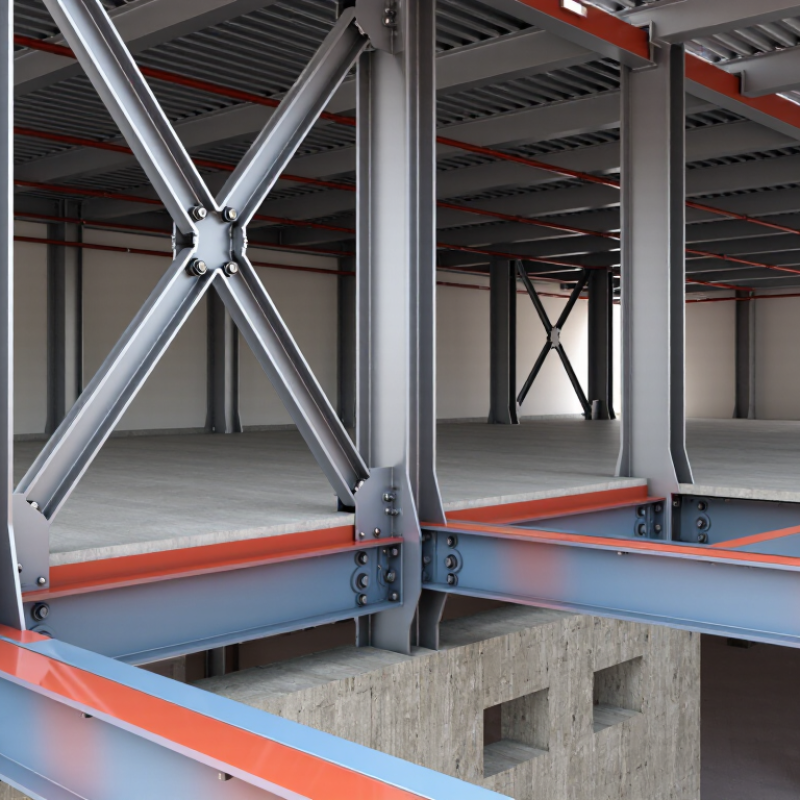
Structural steel forms the frame: columns carry vertical loads, while beams transfer floor and roof loads. The appropriate grade depends on design forces, connection details, and the project environment. The American Institute of Steel Construction’s Specification for Structural Steel Buildings (AISC 360-22) sets requirements for steel design and construction.
In practice, a well-sized connection matters as much as a strong beam. Small details matter.
Bolts and welds connect the frame; their selection and inspection affect how loads move through the structure. Composite floors often pair profiled steel decking with a concrete slab, giving crews a working platform while the slab is placed.
Protective coatings help limit corrosion, especially where moisture or airborne salts are persistent. They still need suitable surface preparation and maintenance. Choosing materials by habit can miss site-specific exposure. A coastal column and an indoor beam may need different protection, even when their structural roles appear similar.
World Steel Association’s World Steel in Figures 2024 reports 1,888.2 million tonnes of crude steel production in 2023, a measure of the material’s industrial scale, not a guide to any one building’s specification.
Key Properties That Make These Materials Suitable
Steel is widely used because it carries heavy loads without requiring unusually thick members. Its strength-to-weight ratio can reduce the weight of beams and columns, while standardized sections make sizing and fabrication more predictable. On site, a steel beam can be lifted into place and joined with bolts or welds. That helps crews work efficiently. It does not remove the need for careful alignment.
Ductility is another important property. Under stress, steel can deform before it fractures, giving engineers useful warning when a structure is overloaded. Its consistent mechanical behavior also supports calculations, provided the correct grade and connection details are specified. Small choices matter. A poorly designed joint can limit the performance of an otherwise suitable beam. I have seen material selection treated as the main decision, when inspection and workmanship deserve equal attention.
Other materials serve different roles. Concrete often provides a stable foundation and can resist compression well, while steel reinforcement helps it handle tension. High-strength bolts create dependable connections when installed and checked correctly. Protective coatings slow corrosion, especially where moisture collects around joints or exposed edges. Still, coatings need maintenance; they are not permanent shields. Even a sound design can be undermined by neglected surface damage or water trapped behind a detail.
How Materials Work Together in Structural Systems
Steel structures perform through cooperation, not through steel alone. Columns and beams carry tension, bending, and compression, while bolts and welds transfer forces between members. In composite floors, concrete slabs resist compression and steel beams provide tensile strength; shear connectors help them act together. Small details matter. A poorly drained connection can trap water, while a missing fire-protection layer can undermine a carefully designed frame.
Material choices also shape a building’s wider impact. The World Steel Association’s World Steel in Figures 2024 reports that construction uses about half of global steel demand. The 2023 Global Status Report for Buildings and Construction, published by UNEP and the Global Alliance for Buildings and Construction, attributes 37% of global energy- and process-related CO₂ emissions to buildings and construction. These figures make efficient layouts, durable coatings, and practical maintenance more than aesthetic choices. Yet more steel does not automatically mean a safer or better structure. Designers must consider load paths, corrosion exposure, fire performance, and how concrete, steel, and connections behave as one system. In practice, coordination can be imperfect; a small clash between a beam and service pipe may force costly changes. Planning helps, but site conditions still deserve careful review.
Why These Materials Work Together in Steel Structures
Typical density of materials commonly used in building structures
Structural steel provides a strong, relatively lightweight frame for carrying loads. Concrete is often used in foundations, floors, or composite slabs; timber may be used for secondary elements; and aluminum for lightweight components. Their different properties let each material serve a specific role. Values are typical approximate densities; actual values vary by grade, mix, species, and product.
Factors Guiding Material Selection
Why Are These Materials Used in Steel Structure Construction?
Factors Guiding Material Selection
Choosing steel for a structure is not just about strength. Engineers weigh loads, span, connection details, fabrication capacity, delivery time, and the building’s environment. A coastal site may need extra corrosion protection; a long-span roof may favor higher-strength sections to reduce weight. Fire performance matters too, because protection systems add cost and affect usable space. Small details count. A weld that is easy to inspect can be more valuable than a slight saving in material.
Carbon and service life also shape decisions. The International Energy Agency’s Iron and Steel Technology Roadmap reports that steel production creates about 2.6 gigatonnes of direct CO₂ emissions annually, around 7% of global energy-system emissions. That makes recycled content, efficient design, and reuse worth checking alongside price. World Steel Association data also show that global crude steel production reached about 1.89 billion tonnes in 2023, underscoring the scale of material demand. These figures do not tell engineers which section to choose, but they make lifecycle impacts harder to ignore. No selection matrix is perfect. Local corrosion records may be incomplete, and a cheaper grade can require more maintenance later. Engineers still need to test assumptions against actual site conditions.
Benefits for Safety, Durability, and Construction Efficiency
Steel is chosen for its strength, long spans, and components that can be fabricated before arriving on site. In a workshop, teams can inspect welds and bolt holes before lifting begins. This reduces some site uncertainty, but it cannot replace sound design or careful erection. McKinsey’s 2019 report, Modular Construction: From Projects to Products, estimates that modular construction can shorten project schedules by 20–50%. Prefabricated steel can help capture those gains when design, transport, and installation are coordinated. Steel is not maintenance-free: coatings, drainage, fire protection, and regular inspections all affect its service life.
Safety comes from the whole system, not the material alone. Properly detailed steel frames can be designed to deform under seismic loads, helping dissipate energy. Connections matter; a strong beam with a poorly designed joint is a weak solution. World Steel Association data reports 1,892 million tonnes of crude steel production in 2023, reflecting the material’s established global production base. Yet availability and quality still vary by region. Engineers should verify grades, fabrication tolerances, and inspection records rather than assume every delivered member is consistent.
Tips: Check connection details before fabrication, confirm coating requirements, and plan lifting routes early. Small coordination gaps can erase schedule gains.
Conclusion
Steel structure construction relies on a combination of materials, including structural steel for beams and columns, steel plates and sections for connections and frames, and concrete or other complementary materials where foundations, floors, or protective systems are needed. The keyword “what materials are used in steel structure construction” points to more than a list: each material is chosen for properties such as strength, stiffness, weight, durability, and ease of fabrication. Together, these materials form structural systems that transfer loads safely while supporting practical building layouts.
Material selection depends on the project’s design, expected loads, environment, budget, and construction schedule. Appropriate coatings and protective details can help limit corrosion and extend service life, while accurate prefabrication and efficient connections can reduce on-site work. When materials are matched to their roles and carefully integrated, they contribute to safety, durability, and faster, more predictable construction.

 Umo House